Subscribe to Webb News
Home
News
Press Releases
For Scientists
Newsworthy Results
2026
2025
2024
2023
2022
2021
Announcements
2026
2025
2024
2023
2022
Picture of the Month
2026
2025
2024
2023
2022
Images
All Images
Picture of the Month
Categories
Anniversaries
Exoplanets
First Images
Galaxies
Graphics
Illustrations
Launch
MIRI
Nebulae
NIRCam
NIRISS
NIRSpec
Picture of the Month
Quasars and Black Holes
Solar System
Spacecraft
Spectroscopy
Stars
Videos
All Videos
Video Formats
About
General
Mission Overview
Fact Sheet
Instruments
MIRI
NIRSpec
NIRCam
NIRISS
Sun Shield
Mirrors
Orbit
Spectroscopy with Webb
Webb & Other Space Telescopes
Webb's Scientific Method
Image Processing
Webb and Europe
International Collaboration
Ariane Launcher
ESA/Webb Outreach Team
Science
Other Worlds
The Lifecycle of Stars
The Early Universe
Galaxies Over Time
FAQ
For Scientists
Newsworthy Results
Initiatives
Webb's First Images
Word Bank
Public Resources
Virtual Meeting Backgrounds
ESA Webb Seeing Farther Brochure
Calendars
2026
2025
2024
2023
Newsletters
ESA/Webb Newsletters
ESA/Webb News
ESA/Hubble/Webb Science Newsletter
Science Announcements
Media
Usage of ESA/Webb Images & Videos
Subscribe to the Media Newsletter
Contact
Picture of the Month 2026
Subscribe to receive news from ESA/Webb!
potm2604 — Picture of the Month
A beacon of light in swirls of dust
7 May 2026
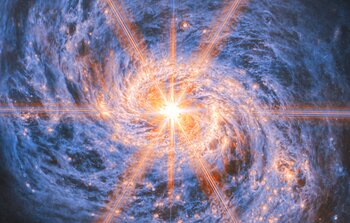
This latest Picture of the Month from the NASA/ESA/CSA James Webb Space Telescope features Messier 77 (M77), a barred spiral galaxy famous and appreciated among astronomers for its combination of relative proximity and spectacular features to study. It is located 45 million light-years away in the constellation Cetus (The Whale). This new image from Webb’s Mid-Infrared Instrument (MIRI) highlights its swirling spiral arms, the dust in its disc and its piercingly bright core like never before. At the heart of M77 is a compact region filled with hot gas that handily outshines the rest of the galaxy put together, even overcoming the light-gathering capacity of Webb’s cameras. This is an active galactic nucleus (AGN), and it’s powered by M77’s central supermassive black hole, which is eight million times as massive as our Sun. Gas in the galaxy’s central regions is pulled by the strong gravity into a tight and rapid …
Read more
potm2603 — Picture of the Month
A pair of planet-forming discs
3 April 2026
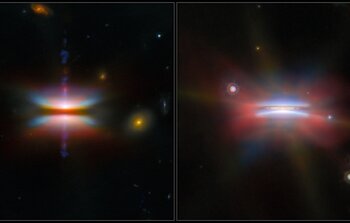
This month’s ESA/Webb Picture of the Month offers us a two-for-one on brand new stars — with some potential planets thrown in as well! This visual highlights views from the NASA/ESA/CSA James Webb Space Telescope of the protoplanetary discs Tau 042021 (left) and Oph 163131 (right), otherwise known by the catalogue numbers 2MASS J04202144+2813491 and 2MASS J16313124-2426281, respectively. Tau 042021 is situated around 450 light-years from Earth in the constellation Taurus, while Oph 163131 lies about 480 light-years away in Ophiuchus. Protoplanetary discs like these appear around stars that have recently been born. When a clump of gas inside a larger molecular cloud collapses to form a star, unused gas and dust is left orbiting the star in a thick disc. Over time, this dust too collides and collapses, slowly forming planetesimals which can, in turn, develop into planets. The planetesimals which can’t make the jump to being a fully-fledged …
Read more
potm2602 — Picture of the Month
The stellar lifecycle in a nearby spiral
20 February 2026
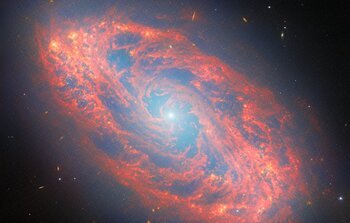
Two powerful instruments of the NASA/ESA/CSA James Webb Space Telescope joined forces to create this scenic galaxy view for today’s Picture of the Month. This spiral galaxy is named NGC 5134, and it’s located 65 million light-years away in the constellation Virgo. Though 65 million light-years may seem like a huge distance — the light that Webb collected to create this image has been journeying to us from NGC 5134 since soon after Tyrannosaurus rex went extinct — NGC 5134 is fairly close by as far as galaxies go. Because of the galaxy’s relative proximity, Webb can spot incredible details in its tightly wound spiral arms. Webb’s Mid-InfraRed Instrument (MIRI) collects the mid-infrared light emitted by the warm dust that speckles NGC 5134’s interstellar clouds, tracing clumps and strands of dusty gas. Some of the dust is composed of complex organic molecules called polycyclic aromatic hydrocarbons, which feature interconnected rings …
Read more
potm2601 — Picture of the Month
A celebrity cluster in the spotlight
22 January 2026
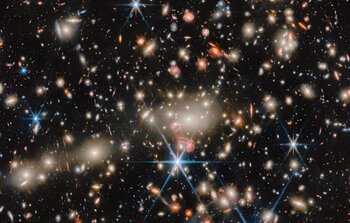
This NASA/ESA/CSA James Webb Space Telescope Picture of the Month brings us a scene from the distant Universe. Pictured here is the galaxy cluster MACS J1149.5+2223, or MACS J1149 for short, which is located about 5 billion light-years away in the constellation Leo. Galaxy clusters are the largest structures in the Universe that are held together by gravity. Astronomers have confirmed more than 300 galaxies belonging to the MACS J1149 cluster, and they’ve identified several hundred more possible members. At the cluster’s centre, a huddle of ghostly elliptical galaxies rules over the cluster with their immense gravity. The crushing gravity of this cluster does more than just hold all the galaxies together as they drift through space. As light from galaxies located behind the cluster makes its way toward our telescope, journeying for billions of years, its path through spacetime is bent by the mass of the intervening galaxies. This …
Read more
Showing 1 to 4 of 4
1
Usage of ESA/Hubble/Webb Images and Videos
Are you a journalist? Subscribe to the ESA/Hubble/Webb Media Newsletter.